Measuring Units Worksheet Answer Key PDF: A Comprehensive Plan
This resource offers a free, downloadable PDF, designed for both students and educators, simplifying conversions between various measuring units – length, weight, and volume.

Measuring units worksheets are fundamental tools in mathematics education, designed to reinforce a student’s grasp of diverse measurement systems. These worksheets, particularly those accompanied by an answer key PDF, provide structured practice in understanding and converting between units like inches, feet, meters, liters, and grams.
The core purpose extends beyond rote memorization; they cultivate practical skills essential for everyday life and scientific applications. A comprehensive measuring units worksheet answer key isn’t merely a solution guide, but a learning aid, enabling self-assessment and pinpointing areas needing further attention.
These resources cater to various learning styles, offering visual and numerical challenges. They are invaluable for educators seeking to assess student comprehension and tailor instruction accordingly, ensuring a solid foundation in measurement concepts.
Understanding the Importance of Answer Keys
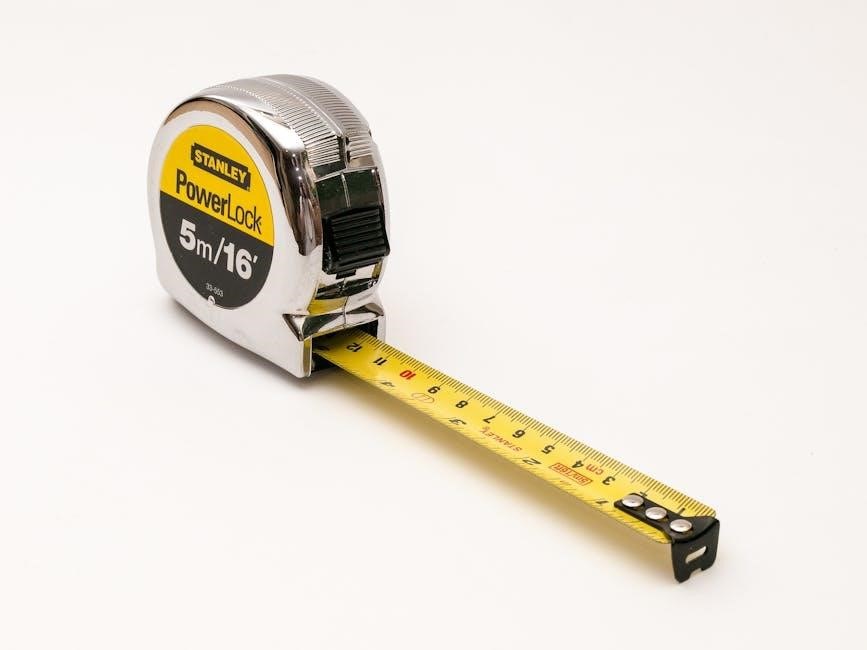
Answer keys accompanying measuring units worksheets are critical components of the learning process, extending far beyond simply providing correct solutions; A detailed measuring units worksheet answer key PDF empowers students to engage in self-directed learning, fostering independence and accountability.
Immediate feedback allows for rapid error correction, preventing the reinforcement of incorrect concepts. Educators benefit immensely, saving valuable time previously spent on manual grading, and enabling them to focus on individualized student support.
Furthermore, answer keys serve as valuable teaching tools, demonstrating problem-solving strategies and clarifying common misconceptions. They promote a deeper understanding of measurement principles, ensuring students aren’t just finding answers, but comprehending the ‘why’ behind them.

Types of Measuring Units Covered
These worksheets comprehensively address imperial and metric systems, encompassing length, volume, and weight/mass measurements, providing a robust learning experience.
Length Measurement Units
Understanding length is fundamental, and these worksheets expertly cover both imperial and metric units. Imperial units include inches, feet, yards, and miles – commonly used in the United States. Students will practice conversions like feet to inches (12 inches = 1 foot) and yards to miles (1760 yards = 1 mile).
Metric units, part of the International System of Units (SI), offer a decimal-based system with millimeters, centimeters, meters, and kilometers. The worksheets facilitate conversions such as millimeters to centimeters (10 mm = 1 cm) and meters to kilometers (1000 m = 1 km).
Practical application is key; the worksheets likely include problems requiring students to measure objects and convert between these units, reinforcing their understanding of spatial relationships and measurement precision. The answer key ensures accurate self-assessment and learning.
Imperial Units (Inches, Feet, Yards, Miles)
These units, prevalent in everyday US measurements, require a strong grasp of conversion factors. The worksheet answer key will demonstrate relationships like 12 inches equaling one foot, and 3 feet composing a yard. Students will likely encounter problems converting between these units, such as expressing a length in feet and inches as a total number of inches.
Larger distances are measured in miles, with 1760 yards defining a single mile. The answer key will provide solutions for converting yards to miles and vice versa. Real-world scenarios are often incorporated, asking students to calculate distances for road trips or the dimensions of rooms.
Accuracy is crucial, and the answer key serves as a vital tool for verifying calculations and understanding the practical application of these imperial units. Mastering these conversions builds a foundation for more complex measurement tasks.
Metric Units (Millimeters, Centimeters, Meters, Kilometers)
The metric system, favored in scientific contexts, utilizes base-ten relationships for easy conversions. The worksheet answer key will illustrate how 10 millimeters (mm) constitute one centimeter (cm), 100 cm form a meter (m), and 1000 meters equal one kilometer (km). Students will practice converting between these units, such as expressing a length in centimeters as millimeters.
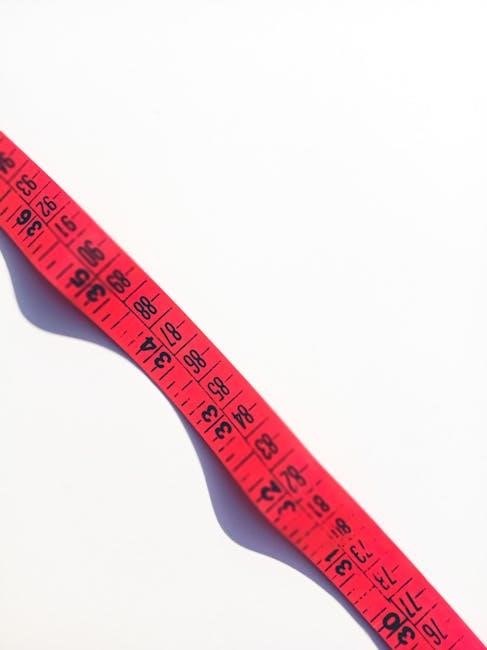
Understanding prefixes like ‘milli-’, ‘centi-’, ‘kilo-’ is key to efficient conversion. The answer key will reinforce these prefixes and their corresponding powers of ten. Practical applications include measuring the dimensions of objects in a laboratory setting or calculating distances on a map.
The SI system emphasizes meters as the base unit for length, and the answer key will consistently demonstrate conversions to and from meters. Accuracy and a firm grasp of these relationships are essential for success.
Volume Measurement Units
Volume, the amount of space an object occupies, is assessed using distinct units. The worksheet answer key provides practice converting between both imperial and metric volume measurements. Imperial units include fluid ounces (floz), cups (c), pints (pt), quarts (qt), and gallons (gal), with defined relationships between each – for example, 16 fluid ounces make a pint.
Metric volume centers around milliliters (mL) and liters (L), where 1000 milliliters equal one liter. The answer key will demonstrate these conversions, aiding students in understanding the scale differences. Real-world applications involve measuring liquids in recipes or determining the capacity of containers.
Problem-solving will involve scenarios requiring conversions, such as determining how many cups are in a gallon or liters in a specific volume of fluid ounces.
Imperial Units (Fluid Ounces, Cups, Pints, Quarts, Gallons)
The Imperial system for volume utilizes fluid ounces, cups, pints, quarts, and gallons, each relating to the next through specific conversion factors. The answer key will detail these relationships: 16 fluid ounces constitute one cup, two cups equal a pint, two pints form a quart, and four quarts make up a gallon.
Worksheet problems will likely involve converting between these units, requiring students to multiply or divide by the appropriate conversion factor. For example, converting gallons to fluid ounces necessitates multiplying by 128 (4 quarts/gallon * 2 pints/quart * 16 fluid ounces/pint).
Practical application includes recipe scaling and understanding container sizes. The key provides accurate answers, reinforcing comprehension of these commonly used volume measurements.
Metric Units (Milliliters, Liters)
The metric system employs milliliters (mL) and liters (L) for volume measurement, based on powers of ten, simplifying conversions. The answer key will clearly demonstrate that 1000 milliliters equate to one liter. This base-ten relationship is fundamental to understanding metric volume.
Worksheet exercises will focus on converting between these units, often involving multiplying or dividing by 1000. For instance, converting liters to milliliters requires multiplying by 1000, while the reverse involves division.
The key provides precise answers, aiding students in mastering metric volume conversions. Furthermore, the document highlights the liter as a base unit for scientific measurement, alongside meters and grams.
Weight/Mass Measurement Units
The worksheet answer key comprehensively covers both Imperial and Metric units for weight/mass. Imperial units include ounces, pounds, and tons, while the metric system utilizes milligrams, grams, and kilograms. Understanding the relationships between these units is crucial for accurate calculations.
The key provides solutions for converting between these systems, emphasizing the importance of conversion factors. For example, students will find answers demonstrating how many grams are equivalent to a specific number of ounces.
The document reinforces that the metric system, with grams and kilograms, is the standard for scientific measurement. It also clarifies the distinction between weight and mass, though the worksheet primarily focuses on numerical conversions.
Imperial Units (Ounces, Pounds, Tons)
The answer key meticulously details conversions within the Imperial system of weight measurement. Specifically, it provides solutions involving ounces, pounds, and tons, enabling students to practice and verify their calculations. The key demonstrates how to convert between these units, for instance, determining the number of ounces in a given number of pounds.
It’s crucial to understand that 1 pound equals 16 ounces, and 1 ton equals 2000 pounds – these relationships are consistently applied in the provided answers. The worksheet likely includes problems requiring students to apply these conversion factors in various scenarios.
The document aims to build proficiency in handling these common, everyday units of weight, preparing students for real-world applications. Answers for problems involving tons are also included, showcasing larger-scale weight measurements.
Metric Units (Milligrams, Grams, Kilograms)
The answer key comprehensively covers the metric system’s weight/mass units: milligrams, grams, and kilograms. It provides detailed solutions for converting between these units, reinforcing the base-ten relationship inherent in the metric system. Students will find examples demonstrating conversions like milligrams to grams and grams to kilograms.
Crucially, the key highlights that 1 gram equals 1000 milligrams, and 1 kilogram equals 1000 grams. The worksheet problems likely require applying these conversion factors to solve practical scenarios. The document emphasizes the scientific context of these units, aligning with the International System of Units (SI).
The provided answers ensure students grasp the proportional relationships within the metric system, fostering a strong foundation for scientific measurement and calculations. It’s designed to build confidence in handling metric mass measurements.
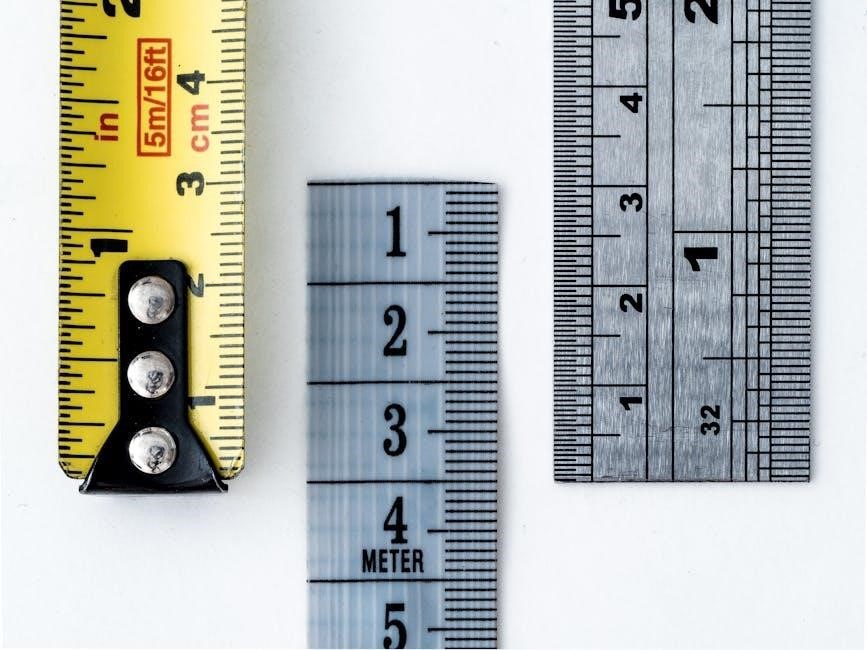
Common Conversions & Problem Solving
The answer key facilitates mastering essential conversions – imperial to imperial, metric to metric, and crucially, between these systems, aiding problem-solving skills.
Converting Between Imperial Units
Imperial unit conversions, as demonstrated in the worksheet, involve understanding relationships like 12 inches equaling one foot, three feet making a yard, and 1760 yards constituting a mile.
The provided data showcases conversions within volume too; for instance, 16 fluid ounces form a pint, two pints create a quart, and four quarts equal one gallon.
Weight conversions are also present, with 16 ounces equaling a pound and 2000 pounds defining a ton.
The answer key meticulously details these conversions, enabling students to accurately transform measurements. Examples include converting feet to inches (multiplication by 12) or gallons to pints (multiplication by 8).

Successfully navigating these conversions is vital for real-world applications and building a strong foundation in measurement principles.
Converting Between Metric Units
Metric conversions, central to the worksheet, rely on a base-ten system, simplifying transformations. The answer key illustrates conversions like 1000 millimeters equaling one meter and 1000 meters defining a kilometer.
For volume, 1000 milliliters constitute one liter, a fundamental relationship emphasized in the provided solutions.
Mass conversions are equally straightforward: 1000 milligrams equal one gram, and 1000 grams define a kilogram.

The worksheet’s answer key provides clear examples, such as converting centimeters to meters (division by 100) or liters to milliliters (multiplication by 1000).
Mastering these metric conversions is crucial for scientific measurement and understanding the International System of Units (SI), fostering precision and consistency.
Converting Between Imperial and Metric Units
Bridging the gap between Imperial and Metric systems presents a unique challenge, addressed within the worksheet’s answer key. These conversions aren’t based on simple multiples of ten, requiring specific conversion factors.
The key likely provides approximations for conversions like inches to centimeters (1 inch ≈ 2.54 cm) and pounds to kilograms (1 pound ≈ 0.4536 kg).
Fluid ounce to milliliter conversions (1 fl oz ≈ 29.574 ml) and gallon to liter conversions (1 gallon ≈ 3.785 liters) are also essential.
Understanding these factors is vital for real-world applications, particularly when dealing with international standards or scientific data.
The answer key’s accuracy in these conversions ensures students grasp the nuances of both systems and can confidently navigate between them.

Analyzing Worksheet Content (Based on Available Data)
The provided data reveals a focus on practical unit conversions, including gallons, cups, feet, pints, and yards, alongside numerical patterns and time conversions.
Focus on Gallons, Cups, Feet, Pints, and Yards
The worksheet prominently features conversions involving gallons, cups, feet, pints, and yards, indicating a strong emphasis on these commonly used units. For instance, the data includes values like “10 gal,” “96 c,” “141 ft,” “58 pt,” and “21 yd,” suggesting frequent practice with these specific measurements.
These units represent both liquid volume (gallons, cups, pints) and linear measurement (feet, yards). The presence of multiple instances of these units – such as “72 qt” and “272 c” – implies a need for students to master conversions within these systems, as well as potentially between them.
Understanding relationships like how many cups are in a pint, or how many feet are in a yard, is crucial. The worksheet likely tests these foundational conversion skills, preparing students for more complex measurement problems.
Identifying Numerical Patterns in Provided Answers (e.g., 96 c, 141 ft)
Analyzing the answer key reveals specific numerical values associated with different units, such as “96 c” (cups) and “141 ft” (feet). Recognizing patterns within these numbers can aid in understanding conversion factors and reinforcing measurement concepts. For example, the presence of multiples like 96 suggests a relationship to other units, potentially involving factors of 8 or 12.
Further examination shows values like “642 p t” and “768 fl oz”, hinting at potential scaling or grouping within the measurement system. Identifying these patterns isn’t about memorization, but about developing a logical approach to problem-solving.
Students can benefit from noticing these numerical relationships, as it fosters a deeper comprehension of how units relate to one another and strengthens their ability to predict and verify answers.
Recognizing Time Conversions (e.g., 642,000 s = 10.7 minutes)
The answer key incorporates time conversions, exemplified by “642,000 s = 10.7 minutes,” demonstrating the relationship between seconds and minutes. This highlights the importance of understanding different time units and their interconversion. Such examples aren’t isolated; they represent a broader need to translate between various temporal scales.
Students can utilize these conversions to practice dimensional analysis and reinforce their understanding of time measurement. Recognizing these patterns helps build fluency in converting between seconds, minutes, hours, and even larger units like days.
This conversion serves as a practical application of mathematical principles, linking abstract concepts to real-world scenarios, like the impact of smoking on life expectancy, as presented in the provided data.

Resources & Accessibility
This key is readily available as a free PDF download, catering to students and educators alike, and contextualizes units within the SI system.
Free PDF Download Availability
Accessing this invaluable measuring units worksheet answer key is remarkably straightforward. It’s offered as a complimentary PDF download, ensuring broad accessibility for students, teachers, and homeschooling parents. This digital format allows for easy printing and distribution, facilitating seamless integration into lesson plans or independent study routines.
The PDF is designed to be user-friendly, with clear formatting and organized answers. It eliminates the need for manual answer creation, saving educators valuable time and effort. Furthermore, the downloadable nature of the file means it can be readily stored and accessed on various devices – computers, tablets, and smartphones – providing flexibility and convenience.
This resource is intended to support learning and assessment, making the complexities of unit conversions more manageable. The availability of a free PDF ensures that quality educational materials are accessible to everyone, regardless of budgetary constraints.
Target Audience: Students and Educators
This comprehensive measuring units worksheet answer key is purposefully designed to cater to a dual audience: students striving to master measurement concepts and educators seeking reliable, time-saving resources. For students, the answer key provides immediate feedback, reinforcing learning and identifying areas needing further attention. It fosters independent learning and builds confidence in tackling measurement problems.
Educators will find this PDF invaluable for streamlining assessment and lesson planning. It eliminates the tedious task of manually creating answer keys, allowing them to focus on individualized student support and curriculum development. The clear, concise answers ensure accurate grading and consistent feedback.
Whether utilized in classrooms, homeschooling environments, or for supplemental practice, this resource empowers both learners and instructors to navigate the world of measuring units with greater ease and understanding.
SI Units and Scientific Measurement Context
The worksheet and its accompanying answer key implicitly support understanding of the International System of Units (SI), the globally recognized standard for scientific measurement. SI units provide a consistent and unambiguous framework for expressing quantities, crucial for accurate data analysis and reproducibility in scientific endeavors.
The base units – meters for length, grams for mass, and liters for volume – are foundational. Conversion charts within the resource facilitate movement between metric units, reinforcing the decimal-based nature of the SI system. This understanding extends beyond simple conversions; it builds a conceptual grasp of scale and magnitude.
By utilizing this resource, students develop a skillset applicable not only to everyday measurements but also to more advanced scientific contexts, preparing them for success in STEM fields and fostering a deeper appreciation for the precision of measurement.