Math literacy empowers individuals to navigate a quantitative world, fostering informed decisions and critical thinking skills for success in diverse life scenarios.
What is Math Literacy?
Math literacy extends far beyond rote memorization of formulas and procedures; it’s a comprehensive understanding of how mathematical concepts apply to real-world situations. It’s the ability to define, interpret, and communicate mathematical information effectively.
Essentially, a math-literate person can confidently tackle quantitative challenges encountered in daily life – from managing personal finances and understanding news reports to interpreting data and making informed decisions. This involves not just doing math, but thinking mathematically.
It’s about recognizing when mathematical tools are needed, selecting appropriate methods, and critically evaluating the reasonableness of results. Crucially, math literacy isn’t limited to achieving high scores on standardized tests; it’s about possessing the practical skills and conceptual understanding to thrive in a data-driven society. It’s a foundational skill for informed citizenship and professional success.
Why is Math Literacy Important?
Math literacy is paramount in today’s world, impacting nearly every facet of modern life. A strong foundation in mathematical reasoning empowers individuals to make sound financial decisions, such as budgeting, investing, and understanding loan terms. It’s crucial for interpreting statistics presented in the media, allowing for informed opinions on important social and political issues.
Furthermore, many career paths, even those not traditionally considered “math-heavy,” increasingly require quantitative skills. From healthcare professionals calculating dosages to marketers analyzing data, math literacy is a valuable asset.
Beyond professional benefits, it fosters critical thinking, problem-solving abilities, and logical reasoning – skills transferable to all areas of life. Ultimately, math literacy isn’t just about numbers; it’s about empowering individuals to navigate a complex world with confidence and make informed choices.

Foundational Math Skills
Essential skills encompass a solid grasp of arithmetic, number manipulation, and the ability to apply these concepts to solve basic mathematical problems effectively.
Number Sense & Operations
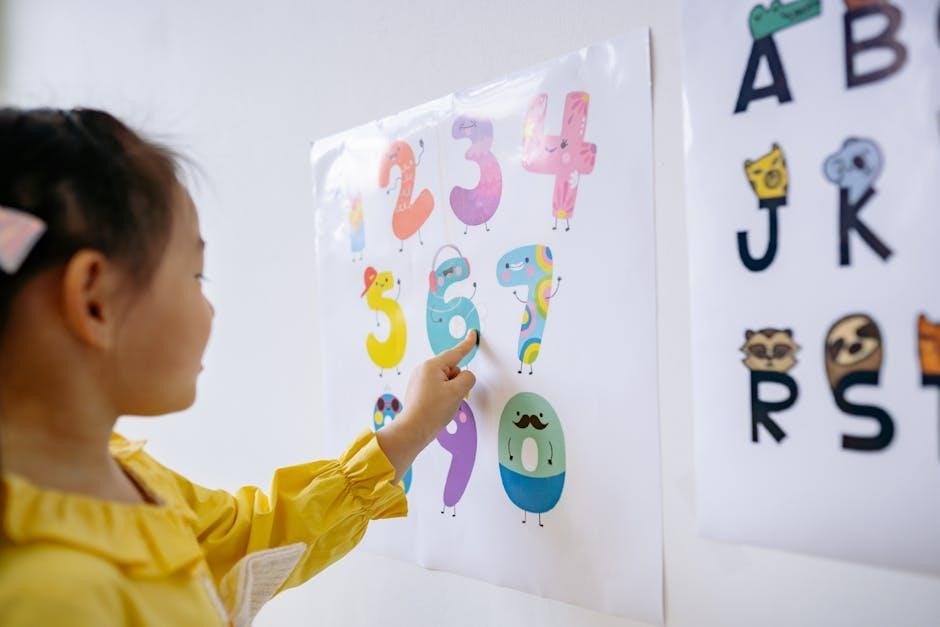
Developing strong number sense is paramount to mathematical proficiency. This involves understanding the relationships between numbers, their magnitudes, and their representations. It’s not simply memorizing facts, but truly feeling what numbers mean.
Core operations – addition, subtraction, multiplication, and division – form the bedrock of all further mathematical study. Mastery requires fluency, accuracy, and the ability to apply these operations in various contexts. Understanding the inverse relationship between addition and subtraction, and multiplication and division, is crucial.
Beyond rote calculation, focus on estimation and mental math. Can you quickly approximate the answer to 27 x 8? Number sense allows for reasonable estimations without needing a calculator. Furthermore, exploring different strategies for computation – breaking down problems, using properties of operations – fosters flexibility and deeper understanding. This foundational skill set is vital for tackling more complex mathematical challenges later on, and for everyday problem-solving.
Understanding Fractions, Decimals & Percentages
Fractions, decimals, and percentages are interconnected representations of parts of a whole. A solid grasp of these concepts is essential for interpreting information in everyday life, from calculating discounts to understanding statistics.
Begin with fractions – understanding numerator and denominator, equivalent fractions, and operations with fractions (addition, subtraction, multiplication, division). Visual models, like pie charts or number lines, are incredibly helpful. Then, connect fractions to decimals through division. Recognize that a decimal is simply another way to represent a fraction with a denominator of a power of ten.
Percentages build upon this foundation, representing a fraction out of 100. Practice converting between fractions, decimals, and percentages seamlessly. Real-world applications, such as calculating tips, taxes, or interest rates, solidify understanding. Emphasize the ‘percent’ means ‘out of one hundred’ to build conceptual clarity, avoiding purely procedural memorization.
Basic Algebra Concepts
Algebra introduces the use of variables to represent unknown quantities, forming the foundation for solving equations and understanding relationships between numbers. Start with the concept of a variable as a placeholder – a letter representing a number we haven’t yet determined.
Focus on simplifying expressions by combining like terms. This reinforces the idea that mathematical operations follow specific rules. Then, introduce the concept of equations – statements that show equality between two expressions. Emphasize the importance of maintaining balance when solving for a variable; whatever operation is performed on one side must also be performed on the other.
Practice solving simple one-step and two-step equations. Relate algebraic concepts to real-world scenarios, such as calculating the cost of items or determining distances. Avoid abstract exercises initially; contextualize problems to enhance understanding and engagement. Building a strong foundation here is crucial for future mathematical success.

Real-World Applications of Math
Applying math to everyday situations—from budgeting and cooking to understanding statistics—demonstrates its practical value and builds confidence in problem-solving abilities.
Math in Personal Finance
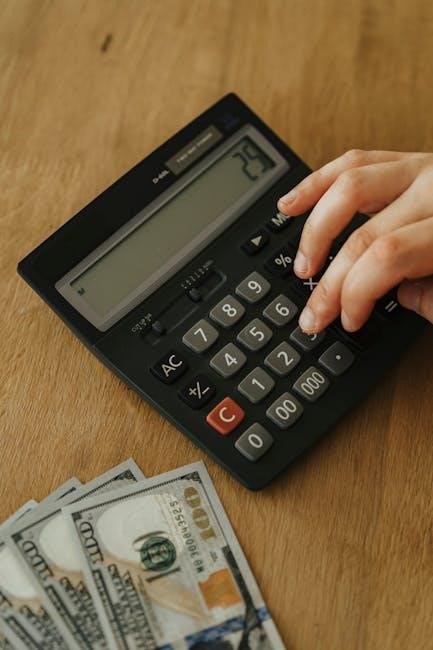
Managing finances effectively relies heavily on mathematical skills. Budgeting, for instance, requires addition, subtraction, and often percentages to track income and expenses accurately. Understanding interest rates – whether for savings accounts, loans, or credit cards – necessitates calculating percentages and applying formulas to determine long-term costs or gains.
Investing also demands mathematical literacy. Calculating returns on investment, assessing risk, and understanding compound interest are crucial for making informed decisions. Even simple tasks like comparing prices at the grocery store or calculating sales tax involve basic arithmetic. Furthermore, planning for retirement requires projecting future income and expenses, utilizing concepts like present and future value.
Without a solid grasp of these mathematical principles, individuals may struggle to make sound financial choices, potentially leading to debt, poor savings habits, and difficulty achieving financial security. Therefore, math literacy is a cornerstone of responsible personal finance.
Math in Healthcare
Mathematical skills are surprisingly vital within the healthcare field, extending far beyond a doctor’s calculations. Nurses frequently calculate medication dosages, requiring precise conversions between units (milligrams to milliliters, for example) and a strong understanding of ratios and proportions. Accurate dosage calculation is paramount for patient safety.
Interpreting medical charts and graphs – displaying vital signs, lab results, or treatment progress – demands data analysis skills. Healthcare professionals also use statistics to track disease outbreaks, evaluate treatment effectiveness, and understand population health trends. Even understanding probabilities is crucial when discussing risks and benefits of procedures with patients.
Patients themselves benefit from math literacy when understanding prescriptions, interpreting health statistics, and making informed decisions about their care. A basic understanding of percentages helps assess risk factors and evaluate the likelihood of treatment success. Ultimately, math empowers both providers and patients in healthcare.
Math in Everyday Shopping
Navigating the marketplace requires consistent application of mathematical concepts. Calculating discounts – whether percentage-based or fixed amounts – is a fundamental skill for smart shopping. Comparing unit prices (cost per ounce, per pound, etc.) allows consumers to determine the best value, even when package sizes differ. This prevents being misled by deceptive pricing strategies.
Budgeting and tracking expenses rely heavily on addition, subtraction, and sometimes even basic algebra to project future spending. Sales tax calculations are essential for determining the final cost of purchases. Estimating total costs, including tax and potential shipping fees, prevents overspending and financial surprises.
Furthermore, understanding proportions is useful when scaling recipes or determining if a sale truly offers savings. Math literacy empowers consumers to make informed purchasing decisions, maximizing their budget and avoiding unnecessary expenses.
Developing Problem-Solving Skills
Effective problem-solving involves dissecting challenges, applying logical reasoning, and utilizing appropriate strategies to arrive at accurate and well-supported solutions.
Breaking Down Word Problems
Successfully tackling word problems requires a systematic approach. Begin by carefully reading the problem multiple times, identifying the core question being asked. Next, highlight or underline key information – numbers, units, and relationships. Translate the words into mathematical expressions; determine which operations (addition, subtraction, multiplication, division) are needed and why.
Identify what is unknown and assign a variable to represent it. Don’t be afraid to draw diagrams or create tables to visualize the problem. Once you have a mathematical equation, solve it step-by-step, showing your work. Finally, and crucially, check your answer against the original problem to ensure it makes sense in the context. Does the answer logically fit the scenario described? Practicing this method consistently builds confidence and accuracy.
Strategies for Logical Reasoning
Developing strong logical reasoning skills is paramount for math literacy. Employ deductive reasoning – starting with general principles and applying them to specific cases. Conversely, inductive reasoning involves observing patterns and forming generalizations. Practice identifying assumptions within a problem; are there unstated beliefs influencing the solution?
Look for contradictions or inconsistencies in information presented. Utilize “what if” scenarios to test different possibilities and understand the impact of changing variables. Mastering pattern recognition – spotting sequences, relationships, and trends – is also crucial. Regularly engage in logic puzzles, brain teasers, and critical thinking exercises to sharpen these abilities. Remember, logical reasoning isn’t just about finding the right answer, but understanding why that answer is correct.
Using Visual Aids & Diagrams
Visual representations significantly enhance mathematical understanding and problem-solving. Employing diagrams, charts, and graphs transforms abstract concepts into more concrete and accessible forms. Draw a picture – even a rough sketch – to visualize the problem’s components and relationships. Utilize flowcharts to map out sequential steps in a process, clarifying the logical order of operations.
Bar graphs and pie charts effectively illustrate comparisons and proportions. Number lines provide a visual representation of numerical values and their relative positions. Venn diagrams are invaluable for understanding sets and their intersections. Don’t underestimate the power of color-coding and labeling to improve clarity. Regularly practice translating word problems into visual models; this strengthens comprehension and facilitates finding solutions. Visual aids aren’t just for those who “learn visually” – they benefit everyone!
Resources for Improving Math Literacy
Numerous resources are available, including online platforms, comprehensive workbooks, and local community programs, designed to bolster mathematical skills and confidence effectively.
Online Math Tutorials & Websites
The internet offers a wealth of interactive resources for enhancing math literacy. Khan Academy provides free video lessons and practice exercises covering a vast range of mathematical topics, from basic arithmetic to calculus. Its personalized learning dashboard tracks progress and identifies areas needing improvement.
Similarly, websites like Mathway offer step-by-step solutions to math problems, acting as a valuable tool for checking work and understanding concepts. IXL Learning delivers skill-building practice with immediate feedback, adapting to the learner’s level.
For more focused learning, consider platforms like Coursera and edX, which host courses from top universities on subjects like statistics and algebra. These often include graded assignments and certificates upon completion. YouTube channels dedicated to math instruction, such as PatrickJMT and Professor Leonard, provide clear explanations and worked examples. Remember to critically evaluate the source and ensure the content aligns with your learning goals.
Recommended Books & Workbooks
For foundational skill-building, “Life Skills Math” by Don Davis offers practical applications of math concepts to everyday situations. “Basic Math & Pre-Algebra For Dummies” provides a comprehensive review of essential topics with a user-friendly approach. Schaum’s Outlines are excellent for focused practice, covering specific subjects like algebra or geometry with numerous solved problems.
To strengthen number sense and problem-solving abilities, “The Number Devil” by Hans Magnus Enzensberger presents mathematical concepts through an engaging story. Workbooks from publishers like Barron’s and McGraw-Hill offer targeted practice exercises with answer keys.
Consider “Math Doesn’t Suck” by Danica McKellar for a relatable and confidence-boosting approach to algebra. When selecting resources, assess your current skill level and learning style to find materials that best suit your needs. Don’t hesitate to utilize library resources to explore various options before purchasing.
Community Math Programs & Workshops
Local libraries frequently host free math workshops and tutoring sessions for adults, covering topics from basic arithmetic to algebra. Community colleges often offer non-credit remedial math courses designed to build foundational skills and confidence. Explore offerings at your local YMCA or community centers, as they sometimes provide affordable math programs.
Organizations like Khan Academy offer free online courses and practice exercises, often supplemented by in-person study groups organized by local volunteers. Look for adult education centers in your area; they frequently provide comprehensive math literacy programs tailored to diverse learning needs.
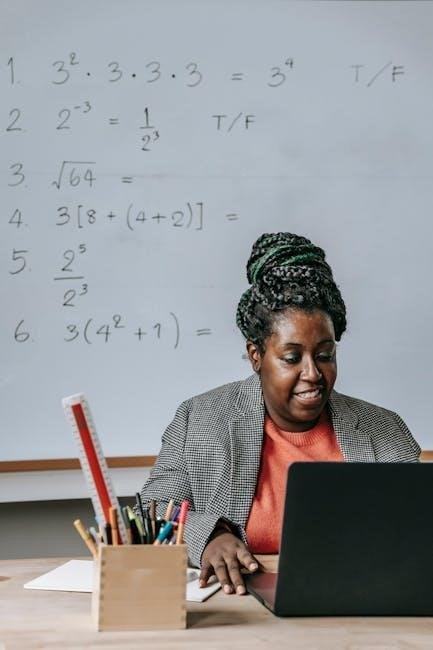
These programs provide a supportive learning environment and opportunities to connect with peers. Participating in workshops can help overcome math anxiety and build a stronger understanding of key concepts. Check local event listings and community bulletin boards for upcoming opportunities.
Advanced Math Concepts (Building Blocks)
Expanding beyond fundamentals, geometry, data analysis, and probability provide crucial tools for interpreting information and solving complex, real-world challenges effectively.
Geometry, at its core, is the study of shapes, sizes, relative positions of figures, and the properties of space. It’s far more than just memorizing formulas; it’s about developing spatial reasoning – the ability to visualize and manipulate objects mentally. This skill is surprisingly crucial in everyday life, from packing a suitcase efficiently to understanding architectural designs.
We begin with fundamental geometric shapes: points, lines, angles, and planes. Understanding these building blocks allows us to explore more complex figures like triangles, squares, circles, and polygons. Key concepts include perimeter, area, and volume – measurements that quantify the extent of these shapes.
Beyond two-dimensional shapes, geometry extends into three dimensions, introducing solids like cubes, spheres, cylinders, and pyramids. Learning to calculate surface area and volume of these solids is essential for practical applications. Furthermore, geometric transformations – translations, rotations, and reflections – help us understand how shapes change without altering their fundamental properties. Geometry provides a visual and intuitive framework for understanding the world around us.
Understanding Data & Statistics
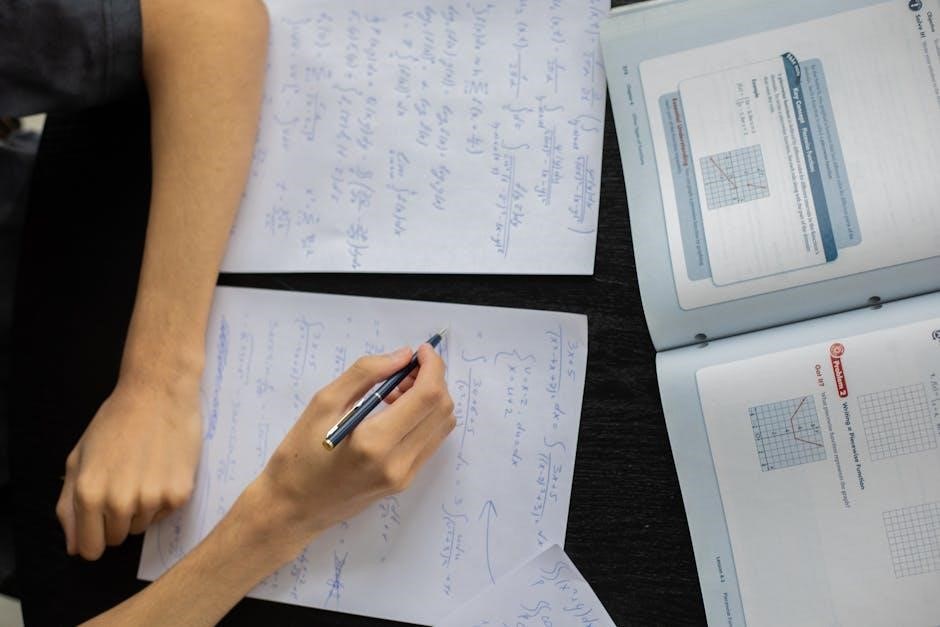
Data and statistics are fundamental to interpreting information in today’s world. This isn’t simply about crunching numbers; it’s about critically evaluating information presented through charts, graphs, and reports. Understanding how data is collected, organized, and analyzed is crucial for making informed decisions.
We start with basic statistical measures: mean, median, and mode – ways to describe the “average” value in a dataset. Then, we explore measures of spread, like range and standard deviation, which indicate how much the data varies. Different types of graphs – bar charts, pie charts, line graphs, and histograms – visually represent data, revealing patterns and trends.
Understanding concepts like correlation (relationships between variables) and causation (one variable directly influencing another) is vital to avoid misinterpretations. Furthermore, recognizing potential biases in data collection and analysis is essential for responsible data interpretation. Statistical literacy empowers individuals to be discerning consumers of information and effective problem-solvers.
Probability & Chance
Probability and chance help us quantify uncertainty and make informed decisions in situations involving randomness. It’s not about predicting the future with certainty, but rather understanding the likelihood of different outcomes. We begin with basic probability – the ratio of favorable outcomes to total possible outcomes, often expressed as a fraction, decimal, or percentage.
Understanding concepts like independent events (where one event doesn’t affect another, like flipping a coin multiple times) and dependent events (where the outcome of one event influences another, like drawing cards without replacement) is crucial. We also explore sample spaces – the set of all possible outcomes – and how to calculate probabilities within those spaces.
Probability isn’t just theoretical; it has practical applications in areas like risk assessment, games of chance, and even medical diagnoses. Recognizing the difference between theoretical probability (what should happen) and experimental probability (what actually happens) is key to interpreting real-world data and making sound judgments.
Overcoming Math Anxiety
Math anxiety is a real obstacle, but it’s manageable! Strategies focusing on building confidence, reframing negative thoughts, and practicing consistently can unlock potential.
Identifying the Root Causes of Anxiety
Understanding where math anxiety originates is the first step toward conquering it. Often, negative experiences during early schooling – perhaps a discouraging teacher, public embarrassment during problem-solving, or pressure to perform – can create lasting emotional associations with mathematics.
These early experiences can lead to a fear of failure, a belief that mathematical ability is innate rather than developed through effort, and a general sense of helplessness when faced with mathematical challenges. Sometimes, anxiety stems from broader issues like test anxiety or a general aversion to structured learning environments.
It’s also crucial to consider societal factors. Cultural stereotypes portraying math as a subject only for “certain” people can contribute to self-doubt. Identifying these personal and external influences allows for targeted strategies to address the underlying causes and rebuild a healthier relationship with mathematics. Recognizing these roots empowers individuals to challenge limiting beliefs.
Techniques for Managing Stress & Building Confidence
Effective stress management is vital when tackling math anxiety. Deep breathing exercises and mindfulness techniques can calm the nervous system before and during problem-solving. Breaking down complex problems into smaller, manageable steps reduces overwhelm and fosters a sense of accomplishment with each completed stage.
Positive reinforcement plays a crucial role; celebrate small victories and focus on effort rather than solely on correct answers. Practicing regularly, even for short periods, builds familiarity and competence. Seeking support from peers, tutors, or educators creates a safe space to ask questions and receive guidance.
Visualization – imagining success – can boost confidence. Reframing negative self-talk into positive affirmations (“I can learn this,” “Mistakes are opportunities to grow”) cultivates a growth mindset. Remember, building confidence is a gradual process requiring patience and self-compassion.
Positive Self-Talk & Mindset Shifts
Cultivating a positive internal dialogue is paramount in overcoming math anxiety. Replace self-deprecating statements like “I’m just not a math person” with empowering affirmations such as “I am capable of learning and improving.” Recognize that intelligence isn’t fixed; embracing a growth mindset – believing abilities can be developed through dedication and hard work – is key.
Challenge negative thought patterns. When encountering difficulty, instead of thinking “I’ll never understand this,” reframe it as “This is challenging, but I can seek help and practice to improve.” View mistakes not as failures, but as valuable learning opportunities.
Focus on the process of learning, not just the outcome. Celebrate effort and persistence. Surround yourself with supportive individuals who encourage your mathematical journey. Remember, a positive mindset significantly impacts performance and fosters a more enjoyable learning experience.